Market Notes for Aug. 15, 2026
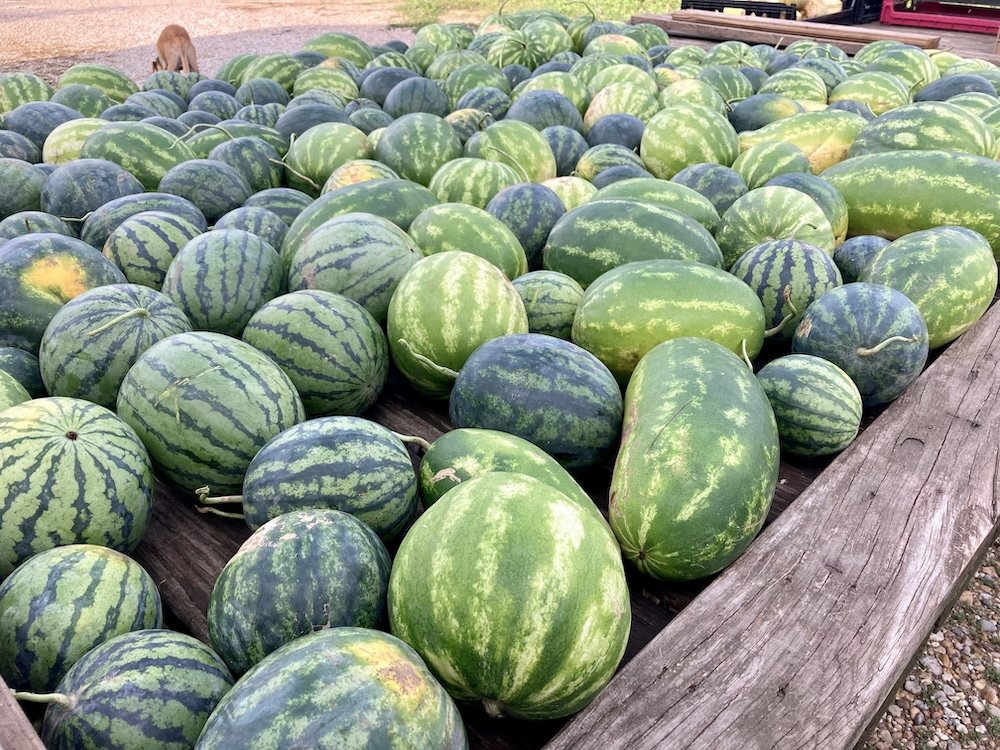
Every melon Henry brings to market it good. Because he only picks the good ones! This week you’ll see a lot of different kinds of watermelon, including Sangria (large and oblong), Crimson Sweet (large and round) and an assortment of different red and yellow varieties.
Food & Farm Notes: MELON 101
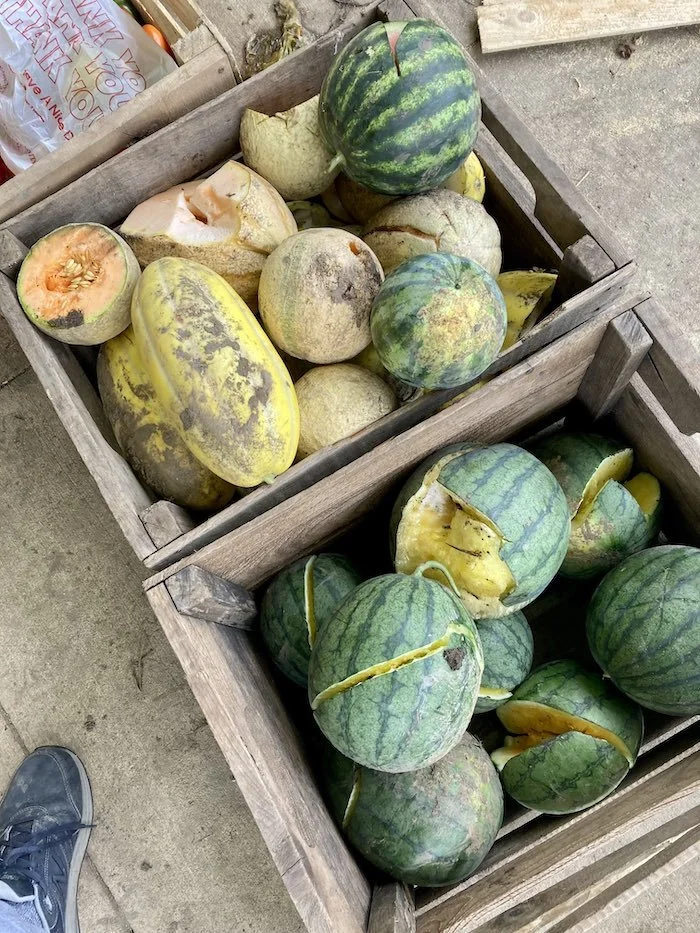
These are the “for-us” melons — those that were so ripe and crisp that they cracked when Henry harvested them, or that were otherwise not good enough to bring to market.
Here are some of the conversations that happen over the melons at Henry’s stand:
Customer: “Pick me a good one.” or “Pick me a ripe one,” or “Pick me a sweet one.”
Henry: “I already did.”
What Henry means is that he only harvests and brings to market good, ripe, sweet melons. If there is any question at all about a particular melon, it stay home and we eat them.
But if you’re looking for the best ones out of all the good ones, Henry says look for ones with a slight crack, or a slightly bad end, or a soft spot somewhere. That’s how you know the melon is dead ripe, and at its peak of flavor and nutrition. It also means you need to eat it right away!
Unlike many other fruits, melons will not sweeten or ripen after they are harvested. The plant transforms sunshine into sugars and pumps them into the melon — but can only do that while it’s still attached to the vine. Once it’s been picked, no more sugar can be pumped in no matter how long a melon sits on your counter. That’s why Henry leaves them on vine until the last possible moment, and that’s why you sometimes see cracks or soft spots.
Because the melons are perfectly ripe, you need to eat your muskmelons within one or two days. The Korean melons can last a few days longer, and the watermelons can last up to a week in your refrigerator.
While all of Henry’s melons that make it to market are sweet, Henry says a general rule is that the largest melons, of a particular variety, have the best chance of being the sweetest.
This Week’s Highlights
First week for Edamame
And the first time for decades that Henry is bring you Lima Beans! This is a pinkish heirloom variety with small, flat beans that are super-buttery and delicious.
Last week for Sweetcorn, and they are nice big ears! Henry was surprised to see more sweet corn in the field than he thought, so he will again be bringing a fair bit up to the market. But this will be your last chance for yellow and bicolor corn, so come and get it!
There will be a small amount of French Breakfast and Purple Radish, and there will also be Radish Greens, which are thinnings from the winter radishes. He needs to provide enough space between individual plants for the Beauty Heart and other big winter radishes to bulk up. And at the same time, he can provide you with nutritious and delicious greens. Unfortunately Henry harvested them after this afternoon’s really hard rain and strong wind beat them up. Henry says they don’t look good, but they taste great!
Unfortunately, it looks like tomorrow will be a rainy harvest day, and Saturday will be a rainy market day. But you need to eat whether it rainy or sunny, and you don’t want to miss out on Henry’s peak season tomatoes, cucumbers, melons, beans, and much more!
First week for Kennebec Potatoes — an old favorite, and for good reasons!
Summer Leeks and Chive Buds ON SALE when you get more than one bunch
And look for the SPECIAL PRICES on all of Henry’s different kinds of Basil and Shiso when you buy more than one
Food Notes: Korean Shiso,
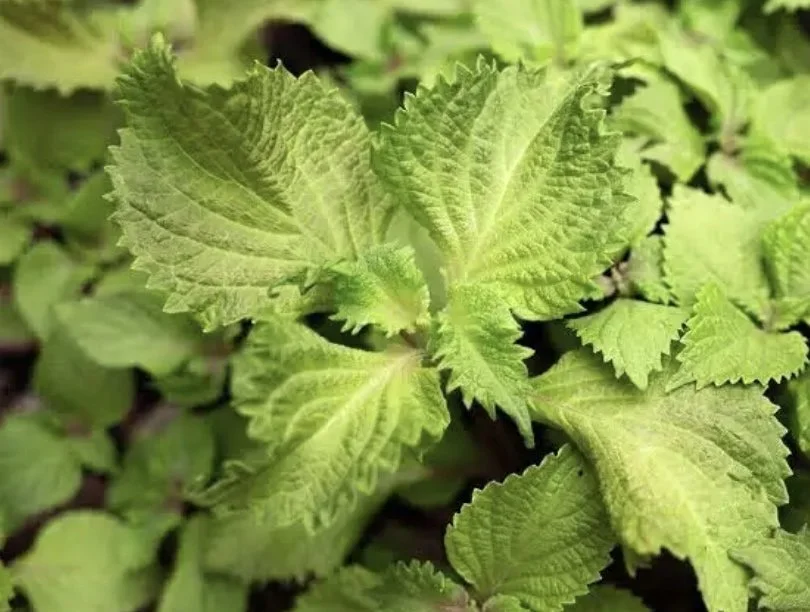
Also known as Sesame Leaf (although it’s not related to sesame), Perilla, and Kkaennip 깻잎, this popular Korean herb a bright flavor somewhere between basil and mint, with spicy undertones.
Koreans often use it for wrapping grilled meat, but you can also use it to wrap just about anything. Or simply chop and sprinkle on soups, salads, stir-fries, and other dishes. Or try the Korean Pancake recipe below, from Maangchi.
Savory Pancake with Korean Shiso
Kkaennip-jangtteok 깻잎장떡
About 30 medium-sized Korean Shiso leaves, chopped
1 cup flour
1 cup water
2 tablespoons doenjang (Korean fermented soybean paste)
1 tablespoon gochujang (Korean fermented hot pepper paste)
¼ cup sliced onion
1 green chili pepper, chopped
3 tablespoons vegetable oil (or any cooking oil will be ok)
Combine the flour, soybean paste, hot pepper paste, and 1 cup water in a bowl. Mix until smooth.
Add the Korean shiso leaves, onion, and green chili pepper. Mix well.
Heat 3 tablespoons of vegetable oil in a large nonstick skillet over medium heat. Swirl the oil to coat the skillet evenly. If your skillet is smaller, you may need to work in batches.
Pour the mixture into the skillet and shape it into a circle. Cook over medium heat for about 5 minutes until the bottom turns golden brown and crispy.
Use a spatula to carefully flip it over and press it down gently. Increase the heat to medium-high and cook for an additional 3 minutes until both sides are golden brown.
Flip it over one more time and cook for an extra minute.
Transfer it to a cutting board and let it cool for 5 minutes. Then, cut it into bite-sized rectangular pieces. Serve as-is, or with rice.
